Monday, April 29, 2013

Monday -Design lab

Today we reviewed your pineapple enzyme design labs and chose 2 possible ideas.

1. Independent Variable - juice type (orange, peach, grape, lemon).


2. Independent Variable - temperature (85, 60, 37, 24)

Part of your homework again tonight is to write up the PROCEDURE. You must have it written out when you arrive tomorrow.

Remember to use your original lab as a guide. You need to have a list of all the materials you need and then the steps (i.e. how to make the jello, how much to add to each tube, how many tubes does each group need). AND then a list of the IV, DEP, etc.

example from your original lab

1.      Label test tubes as “pineapple – hot,” “pineapple – RT,” “apple juice – hot,” “apple juice – RT,” and “water.”  Apply the tape at the top of the test tube with a “tail” as shown at right, so steam from the water bath does not remove the labels.
2.      Prepare gelatin in an appropriate beaker.
a.    Dissolve the contents of a gelatin packet in ¼ cup cold water.
b.    Add ¾ cup boiling water to the mixture and stir until completely dissolved.
3.      Pipette 3ml of juice or water into each test tube according to the labels, using transfer pipettes.  Do not cross-contaminate juices by using a pipette in different types of juice.
4.      Place your “hot” tubes in a beaker of water.  Heat the beaker on the hotplate until a thermometer in the water of the beaker reads 85°C.  Carefully remove the tubes from the heat.  Allow contents to come to room temperature (RT).
5.      Add 10 ml ROOM TEMPERATURE gelatin mixture to each test tube.  Use the big pipette for this and do not let the gelatin drip into the green pipetter.  Shake tubes well to ensure mixing of contents
6.      Refrigerate test tubes overnight.


We also reviewed the sickle cell gel electrophoresis handout. If asked could you answer the following questions..
1. What is the phenotype if someone is Aa? Explain
2. What is a recessive allele?
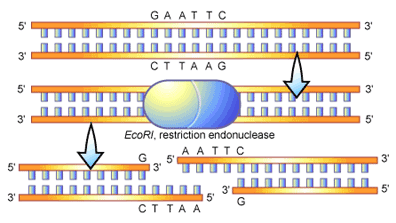
3. How do we use restriction enzymes to determine genotype of sickle cell?

The last part of your homework is the handout below

Saturday, April 27, 2013

Thursday - More on Enzymes

Thursday we worked on the lab involving how proteolytic enzymes and/or heat affect proteins such as collagen. Collagen is a structural protein involved in skin, connective tissue and bones of animals. Below are a couple of images of collagen and how it is organized.


Enzymes have specific 'substrates' or targets on which they work. Some enzymes 'digest' or 'break down' their substrate, while others put 2 targets together. Which type is our 'proteolytic' enzyme from fruit? What is the enzyme's substrate in our lab? Will that enzyme break down another substrate?

Proteins (which is what enzymes are!) can be denatured by heat and some chemicals. This is the process of denaturation.

In our lab, we are looking how 2 variables affect

Monday, April 22, 2013

More on Restriction Enzymes and Gel Electrophoresis

Today we reviewed Restriction Enzymes and Gel Electrophoresis.

Homework for tomorrow: handout from today and prelab questions

Here is a great site for more practice with gel prediction, plasmids, and restriction enzymes.
Practice Reading a Gel (you can do the entire game for more instruction).

Here is a video that also takes you through a tutorial of what we did today.


Sunday, April 21, 2013

Homework for Monday

Please read the article below and watch the video(s) and answer the questions provided. Remember..."is biology destiny?"


15 a life without fear from lvilleDrFox

Here is the video
Friendly to the Extreme: Meet Kids and Adults With Williams Syndrome - ABC News

Wednesday, April 17, 2013

Mutations/Protein Folding and Homework for tomorrow.

Today we reviewed translation and then talked about the videos you watched on Mutations and Protein Folding


HOMEWORK for tomorrow: Finish your electrophoresis lab

Mutations:


A change in the DNA sequence (Nucleotides or larger changes).

Can you identify the Fact or Fiction and explain?

¨ All mutations are bad…………………….¨ Mutations are a source of evolution…¨ Mutation can be silent……………………¨ Mutations only happen when DNA is exposed to things like radiation………………………..


What are the major types of mutation?

Point Mutations
Substitution - single nucleotide change 
Insertion - a base pair is added in the sequence
Deletion - a base pair is removed from the sequence

Both insertion and deletion can also be large chunks put in or removed

Duplication - a large section of DNA on a chromosome is copied. Is this always bad? Can the new portion gain a new function (after a LARGE time frame)

Translocation - the transfer of a piece of one chromosome to a nonhomologous chromosome. Remember the two chromosomes involved typically exchange pieces.

Can you answer the questions below?
1. What is the difference between Substitution and Insertion? Duplication and Translocation?
2. What is a silent mutation?
3. How is mutation involved in evolution?
4. What disease did we discuss that is a change in only 1 nucleotide and is the mutation only bad or does it help?
5. When will a mutation be heritable?


Protein Folding:

Today we talked about how the order and type of the amino acid in a polypeptide determines the folding structure of the protein

What are the 4 levels of protein folding?

Primary - string of amino acids
Secondary - alpha helix or beta pleated sheet
Tertiary - final protein folding (+/- aa come together, hydrophobic aa go on the inside, hydrophillic go on the inside)
Quaternary - multiple proteins fold/come together to form complexes

Here is a good website to try more protein folding


Types of amino acids:
1. Charged (+/-)
2. Polar vs. Nonpolar
3. Special Cases


Tuesday, April 16, 2013

Restriction Enzymes

Today we discussed Restriction Enzymes and Gel Electrophoresis.


Watch the video from start to 9:28 and then using the notes from today and the video:
 Can you answer the following questions?
1. In what organism do you find restriction enzymes?
2. What are restriction enzymes used for in that organism?
3. What are the nucleotide sequences that a restriction enzyme looks for called?
4. Why does the organism's own DNA not get cut into pieces?
5. What are the small circular pieces of DNA called in the organism and what is usually found on these circles?


We also went over how to tell band size resulting from plasmids being cut by restriction enzymes.

Here is a video (watch till 4:50) on how to read a gel


 We also began talking about Gel Electrophoresis. (remember this is also in the above video)

Here is the virtual lab link
Can you answer the questions below?
1. What does GE do?
2. What type of charge does DNA have?
3. What do the black and red cords represent?
4. Which DNA 'runs' closer to the bottom (small or large)?

Here is the picture you will use from your lab to answer the postlab questions (the wells are on the left)


Monday, April 15, 2013

Timid Mice

Today we discussed the timid mice article. You will get more practice reading portions of a scientific article. I've posted a powerpoint. Can you fill out the table on the second slide?

The article discusses how stathmin affected the fear response of mice.